Most of our work sits next to a unit that is still running. We plan the fall so the adjacent plant stays up.
Demolition contractor and demolition expert for live industrial sites in India
Who hires a demolition contractor in India
A plant owner hires a demolition contractor because a chimney, a cooling tower, a conveyor, a hall, or a tank has to come down while the next unit stays on load. The usual site is a cement works, a thermal station, or a process plant. The adjacent plant is ID fans, a second stack, a switchyard, a hospital, quarters, or a highway that has to reopen. The job is detail: survey, fall corridor, hinge or collapse order, PESO on the explosive, exclusion the factory inspector will sign, vibration the running unit can actually take. If those limits cannot be met, the method is wrong, not the firing.
EXIQUDE is that contractor. Jaipur. Own employed crews. Own plant. Anand Sharma, mining engineer, MBM Engineering College, Jodhpur, 1993, has been on blasting and demolition since the 1990s.
Live plant, PESO, constrained sites
Most of our work sits next to a unit that is still running. We plan the fall so the adjacent plant stays up. There is no clearing of the whole station. The usual chimney job in India now is one unit down, one unit up. The design has to assume the live unit stays live.
PESO is the Indian constraint on the explosive, not a badge. Magazine, transport, and the blast sit inside that rule. If permission cannot be obtained, the job moves to Mechanical Dismantling or Non Explosive Demolition. That is a method change, not a delay.
Cement plants, thermal stations, and process units give the same family of constraints: a running kiln or unit, a short outage, houses or plant a few metres off the line, residual ash and liner that someone has to own. Hazardous waste is not a blasting problem, but it stops the job if it is ignored.
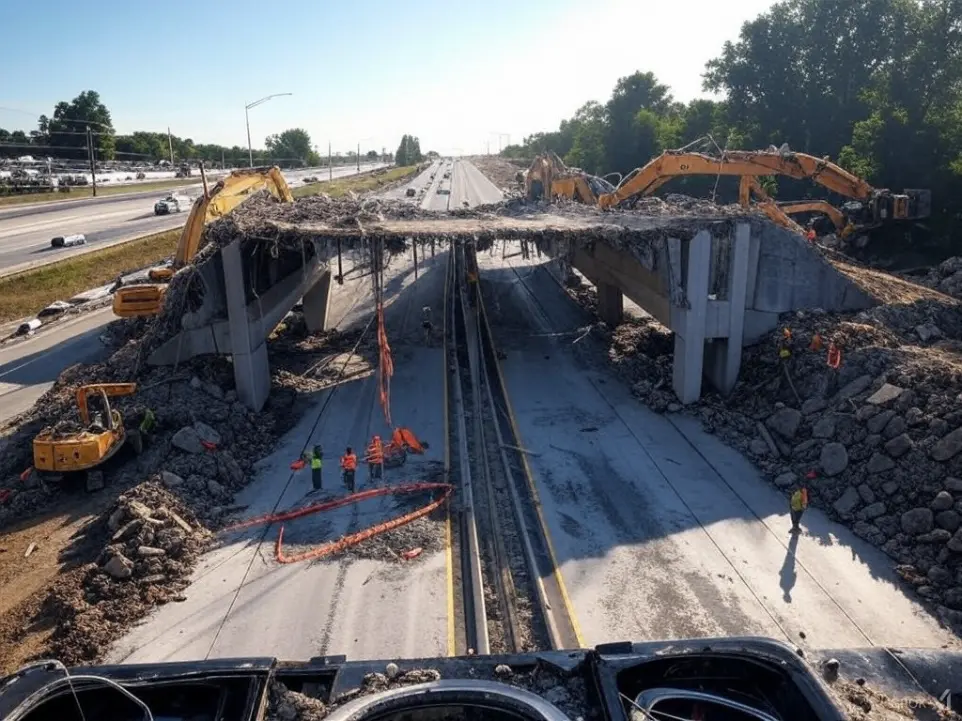
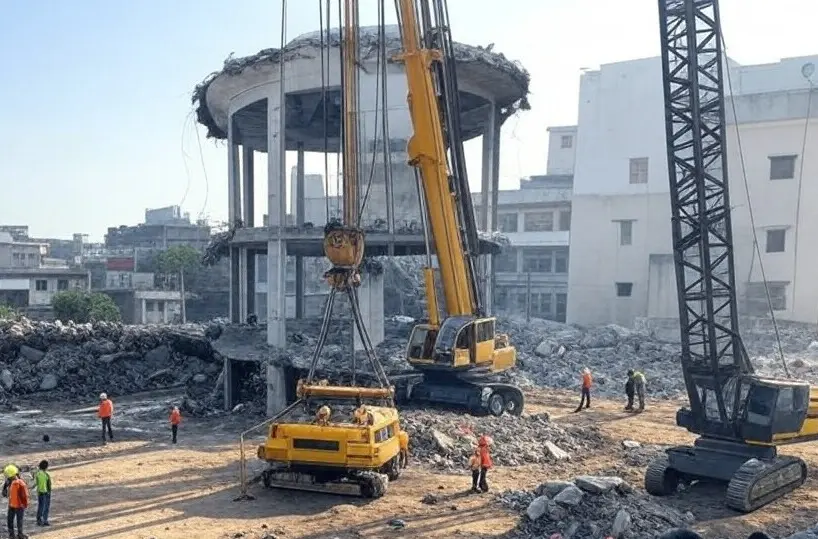
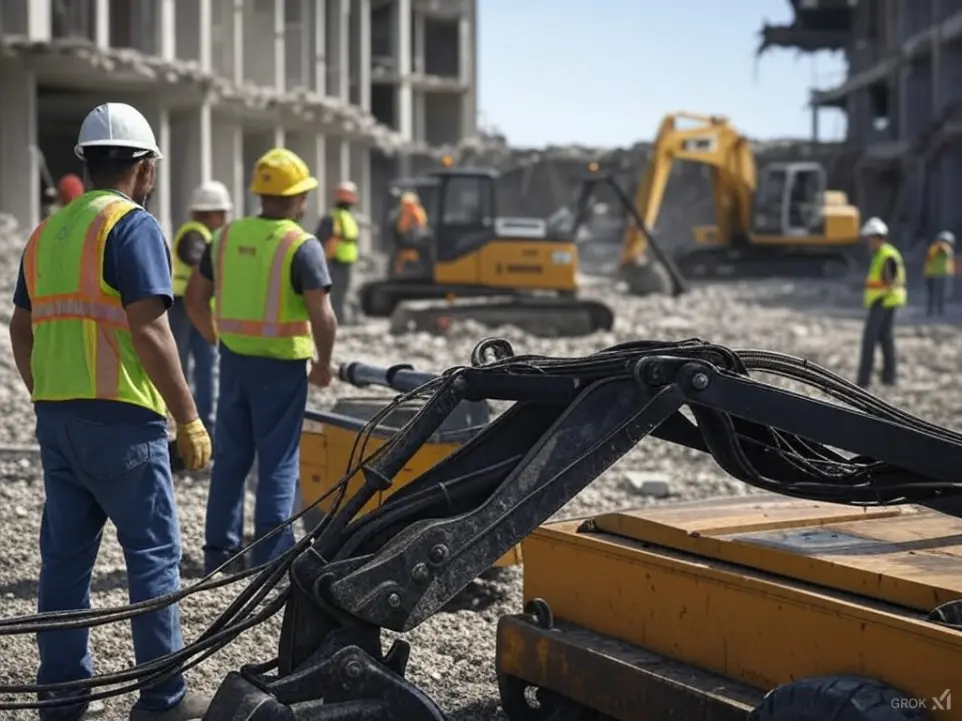
Chimneys
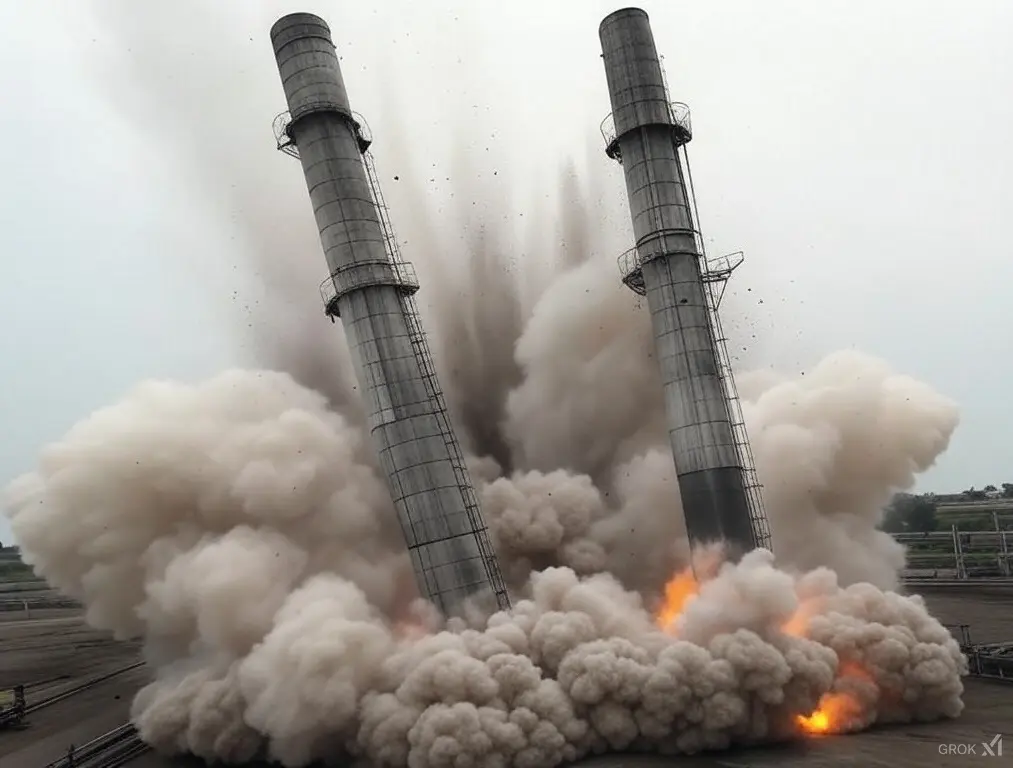
A chimney is a tall, thin, heavily reinforced shell. It does not sit down like a building. We cut a hinge, we choose a fall direction, and we put the shaft on the ground in a corridor we have already cleared. Get the hinge wrong and the shaft can sit, split, or walk toward a running unit. A few degrees off at the hinge is a large miss at the top. Charging is only in the cut zone. The remaining concrete is a line hinge, not a point.
Cooling towers
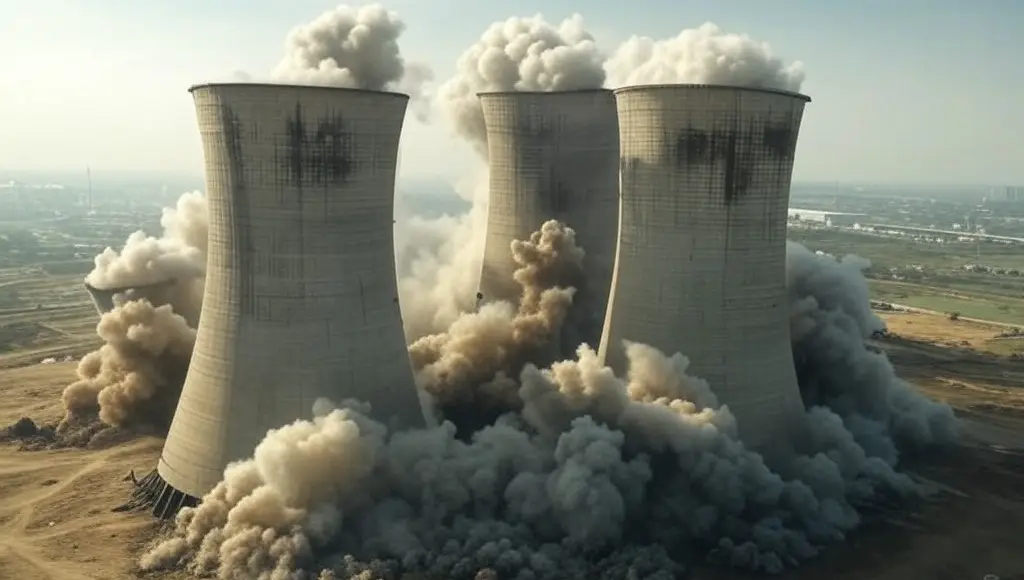
A natural draft cooling tower is a thin hyperbolic shell. The shell stands because the hyperboloid carries load in hoop. A designed cut at the base or throat takes that hoop action away. One tower is a chimney-like problem with a much larger footprint. A row is a plant problem: each shell needs a lane, and vibration and air-blast stack. Four corridors have to be empty at the same instant, or the delays have to put each shell down before the next one needs that ground. A hang-up mid-row is a live-explosive problem. The sequence has to have a stop, not a hope.
Cement plants and plant structures
The usual cement job is inside a working works. A conveyor, a hall, a crusher, a preheater. Silos, kilns, and the rest of the plant stay standing. The method follows the constraint.
Latest Projects
UltraTech Maihar, MP, 2025
Coal conveyor by implosion. Silos and plant around it left standing.
Birla Cement Satna, storage hall, 2024
Clinker hall, running plant. Electronic detonators on this job.
Buildings, tanks, bridges, mechanical
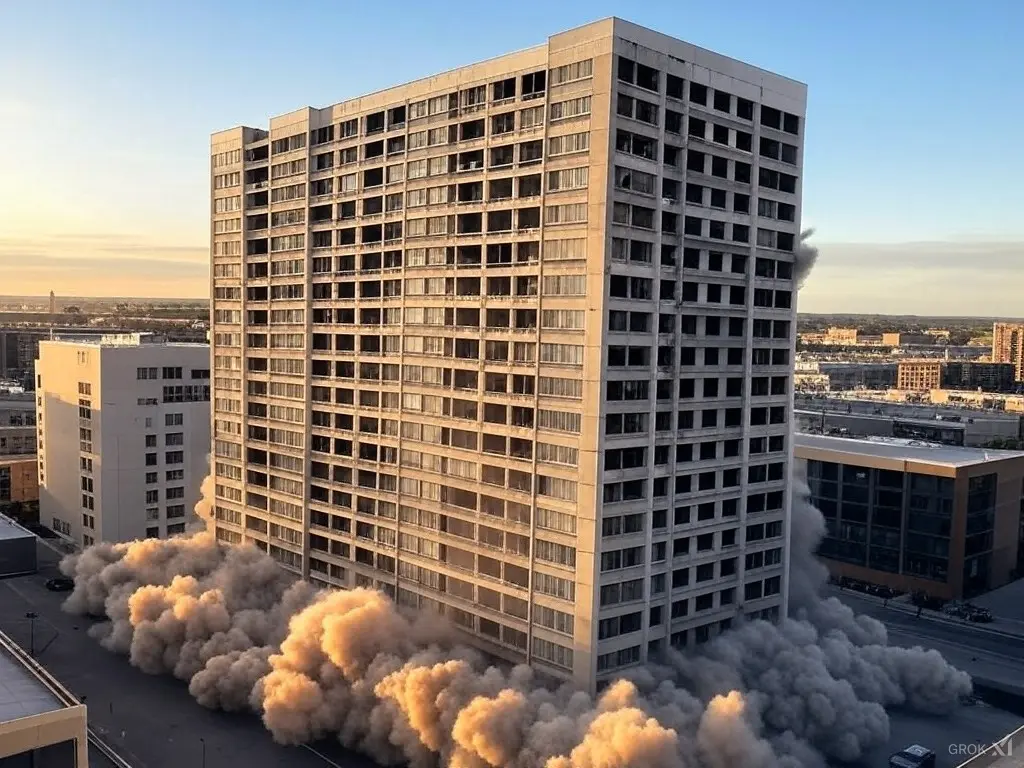
An implosion is a designed collapse. Columns and walls in chosen storeys are weakened so the mass falls into its own footprint or a set corridor. Everything around it has to stay up. A half-fallen frame is no longer the structure you designed. You do not re-fire the original sequence.
Methods
We pick the method from the constraint, not from a catalogue.
Controlled blasting: a chosen fall. Charging only where the design needs a cut.
Controlled implosion: a designed collapse into a footprint or corridor.
Mechanical dismantling: long reach, derrick and winch, or hold and cut, when a blast is the wrong tool.
Non explosive demolition: mineral crack, wire saw, or breaking when vibration and fly have to stay off the adjacent plant.
Quarrying and crushing: deep hole blasting, bulk explosive systems, mobile crush on site.
Scrap recovery and site handover: scrap sorted, site left in a state the plant or the local body can use.
TRUSTED BY INDUSTRY. PROVEN ON SITE.
Contact
Send a drawing, a photo, the window. We will tell you if it is our job.
office@exiqude.com
+91 94140 23887
C-25, 2nd Floor, Pankaj Singhvi Marg, Lal Kothi, Jaipur 302015
www.exiqude.com

Clients